
Paper vs digital business card: for most Indian professionals in 2026 the answer is digital-first, with a few paper cards kept for the formal rooms where one is still expected. A paper card works without any technology and still signals preparation in traditional settings; a digital card updates instantly, can be shared on a call or over WhatsApp, and tells you who actually opened it. If you are weighing the move to a digital business card in India, here is the full comparison and a three-question way to decide before you reprint your stack.
TL;DR
- Paper still wins in rooms where technology is not expected: government offices, traditional trade, family-business introductions.
- Digital wins the moment your details change, the moment you are not in the room, and the moment you want to know who looked.
- The hybrid, an NFC card or a paper card with a QR on the back, removes the trade-off for most people.
- Decide with three questions: how often your details change, whether you want analytics, and where you share.
Before you start
Paper cards still get handed out at every Indian networking event. At every trade show, client meeting and conference in Mumbai, Delhi or Bangalore, someone pulls out a stack of printed cards. Are paper business cards dead? Not quite. But they are increasingly limited, and the limits become obvious the first time you try to keep them current. Before you reprint, it is worth being honest about what each format is actually doing for you.
What you need to decide
- How often your number, designation, company or office changes.
- Where you share your contact: in a room, on a call, over WhatsApp or email.
- Which sector you work in and what its rooms expect.
Step 1: Give paper its due
Paper cards have survived for one reason: they work without friction in the right context. At a traditional industry event, a government office meeting or a family-business introduction, a well-designed physical card still communicates professionalism and preparation. There is a tactile dimension too; embossed text or a matte finish creates a first-moment impression a screen cannot fully replicate, and in luxury retail, law and senior corporate management the physical card still signals seriousness. And paper requires no technology on either side: the recipient needs no phone, no signal, no particular capability. If you are designing one for that impression, the creative visiting card ideas cover finishes that survive a real print run, and local print shop versus online service weighs where to get it printed.
Step 2: See where paper fails
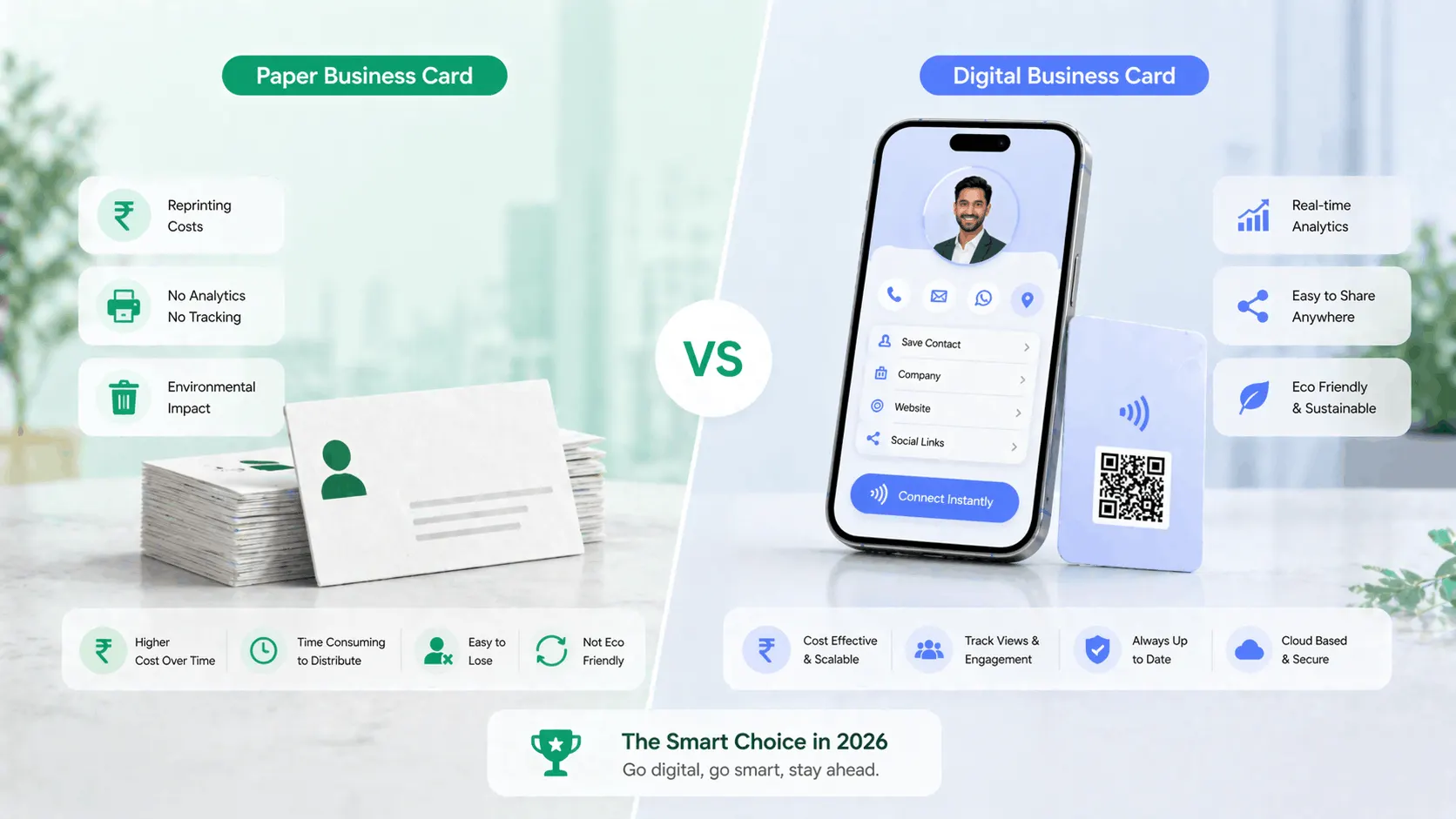
Four limits compound over time. Paper goes out of date instantly: change your number, switch companies, add an office or get promoted, and every card you have ever handed out is now wrong, while a digital profile is edited once and every tap, scan and link reflects it. Paper disappears; many cards are lost or thrown away within days, while a profile saved to a phone is searchable and always there. Paper carries no intelligence; you never learn what happened after the handover, while a profile shows who opened it, when and from which channel. And paper cannot do more than name, number and email, while a profile can carry a portfolio, booking link, Google review button, WhatsApp contact, catalogue and socials, all current.
Step 3: Compare them factor by factor
| Factor | Paper business card | Digital business card |
|---|---|---|
| Cost over time | A print run per version; reprint on every change | Profile is free to create; no reprinting |
| Updatability | No; reprint | Yes; edit any time, live instantly |
| Analytics | No | Yes; views, taps, scans, channel |
| Shareability | In person only | NFC tap, QR scan, WhatsApp link, email signature, URL |
| Where the recipient keeps it | A wallet or a drawer; easily lost | Phone contacts, browser history, bookmarks |
| Content capacity | Name, number, email, designation | Unlimited; links, portfolio, booking, reviews, socials |
| Works without internet | Yes | Partial; tap or scan works, the profile needs data to load |
| Environmental impact | Paper waste | None |
| Adoption in India | Near-universal at traditional events | Growing fast in tech, startup and freelance circles |
| First impression | Familiar, expected | Modern, memorable |
Step 4: Consider the hybrid
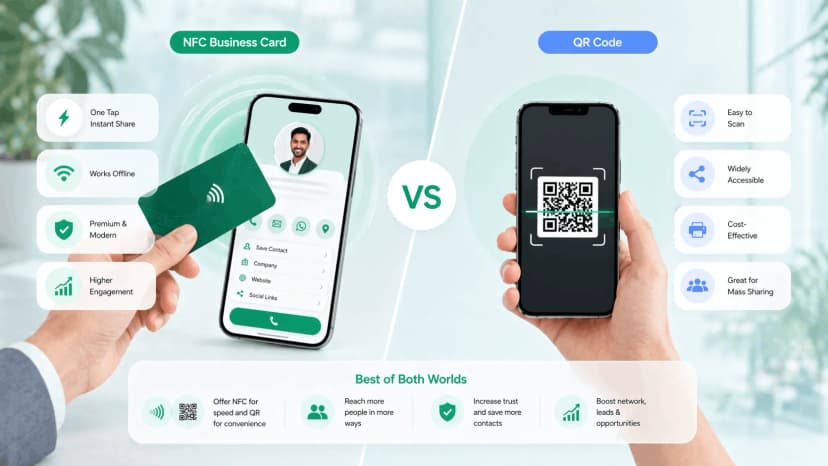
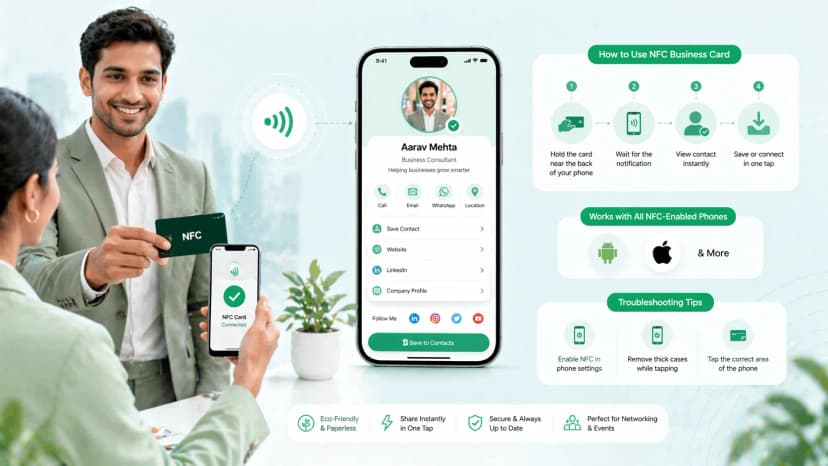
The most practical move for many Indian professionals is not a hard switch. An NFC business card is a physical card that looks and feels premium, but tapping it to a phone opens your full digital profile, so you get the physical exchange and the digital experience at once; NFC card vs visiting card compares that specific pair. Alternatively, print a QR code on the back of a traditional paper card: the card does the work where technology is not expected, and the code gives anyone who wants more a path to a profile that is current even when the card is two years old. The visiting card background guide covers sizes and formats that print cleanly. Some people simply put QR stickers on the stock they already have.
The step people get wrong
Reprinting a thousand paper cards because the old ones have the wrong number, then changing the number again. If your details move more than once every two years, the reprint is the cost you are trying to escape, not the solution.
Step 5: Answer three questions and decide
Do you change your contact details, designation or company more than once every two years? If yes, paper is already costing you. Do you want to know whether the people you share with actually looked? Paper cannot tell you. Do you share your contact when you are not physically present, on calls, over WhatsApp, in email? Digital is the only option there. Three yeses and digital is clearly the fit. If you work in a sector where traditional expectations still dominate, the hybrid lets you do both without compromise.
Honest comparison
Where digital-first is the obvious choice
- Freelancers and consultants whose services, rates and portfolio change often
- Real estate agents on site visits who want WhatsApp, listings and a review button in one tap
- Doctors who want a reception QR instead of a personal number on every card
- Startup and tech teams where paper has already become rare
Where paper still earns its place
- Manufacturing, trading and family businesses where the paper card is part of the ritual
- Government and formal institutional meetings
- Luxury and legal settings where the finish is part of the impression
- Any room where the other person may not have a phone out
Common mistakes
Three ways the switch goes wrong
- Going digital-only in a sector that still expects paper, and having nothing to hand over at the one meeting that mattered.
- Keeping two sets of details, printed and digital, that drift apart. One profile; the paper card points at it.
- Treating the digital card as a page nobody checks. Add the WhatsApp button and the review link; those are what people use.
You're done
In the digital vs paper visiting card comparison, paper loses ground every year, and the paper business card vs digital decision now comes down to how often your details change and where you share them. A ProfileTap profile works by NFC tap, QR scan, direct link and WhatsApp share from one place you update once; create your free digital business card, read how to make a digital business card, compare NFC business card vs QR code, or see how freelancers win clients with digital cards. Doctors have their own route in the digital business card for doctors guide.