
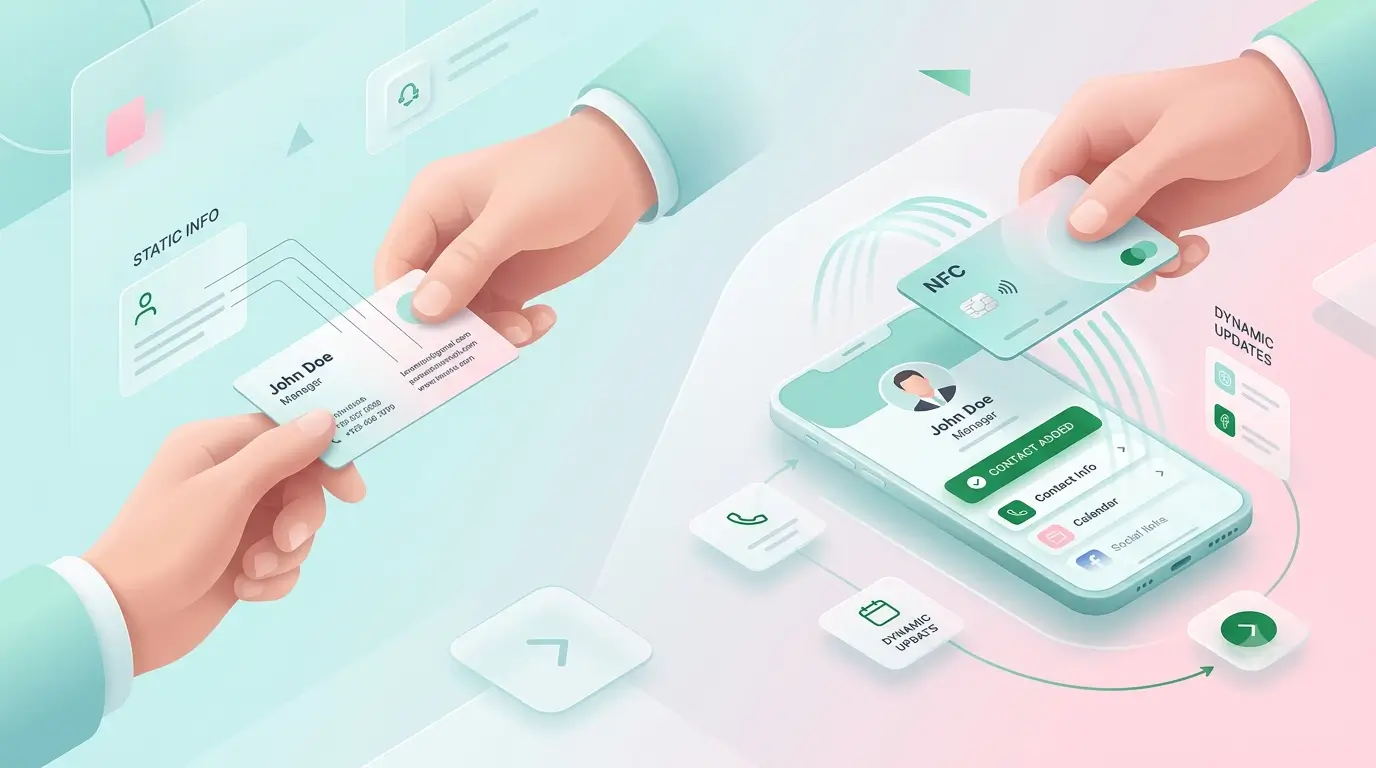
The honest answer to NFC card vs visiting card which is better: they do different jobs. A printed visiting card is fixed the moment it leaves the press; an NFC card holds a link, so the details it opens can change while the card in someone's wallet stays the same. Which one wins depends entirely on how often your details change and where you hand cards out. Most comparisons on this topic are written to sell one side; this guide admits what each is genuinely good at, and walks you through deciding in four steps.
TL;DR
- Print wins on cost per card, on needing no phone, and on being pinned to a board or stapled to an invoice.
- NFC wins the day a detail changes, because every card already handed out updates with your profile.
- Most working professionals in India end up carrying both, with a QR on the paper card opening the same profile.
- The profile is free; the card is a one-time purchase with a GST invoice.
Before you start
Three honest questions settle this faster than any feature list: how often do your details change, how many cards do you hand out in a week, and does the meeting usually end with the other person opening something on their phone? Answer those first and the comparison below mostly confirms what you already know.
What you need
- A rough count of cards handed out per month, and whether most go to walk-ins or to meetings.
- A list of what changed in the last year: number, role, branch, services.
- Ten minutes to set up a free profile, which both options can point at.
Step 1: Count what a printed card still does better
It costs very little per card, so you can hand out hundreds without thinking. It needs no phone, no battery and no signal on either side. It can be pinned to a noticeboard, left on a counter or stapled to an invoice. And a well-made card at 400 GSM still communicates care in a way a tap does not. For a shop that hands out fifty cards a week to walk-in customers, print is not the wrong answer.
Step 2: Count what it costs you the day something changes
A new number, a second branch, a change of role, and every remaining card is quietly wrong, including the ones already in other people's drawers. There is no way to know how many people acted on the old details, and the reprint is the smaller cost; the enquiries that went to the old number are the bigger one.
Step 3: See what the NFC card changes
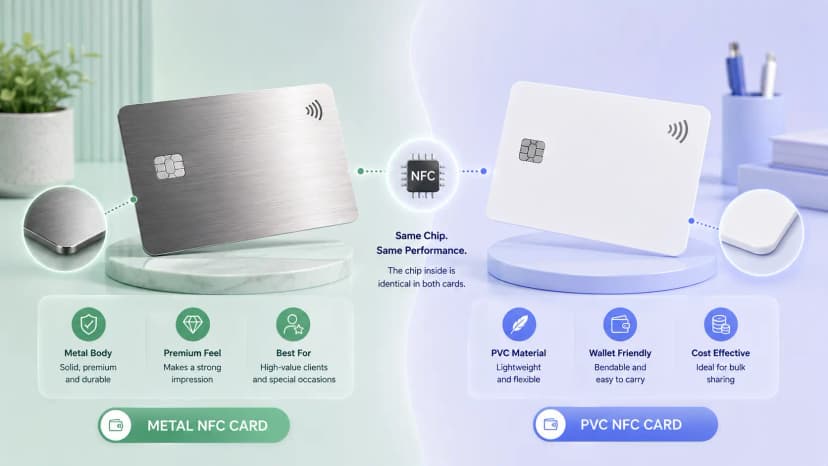
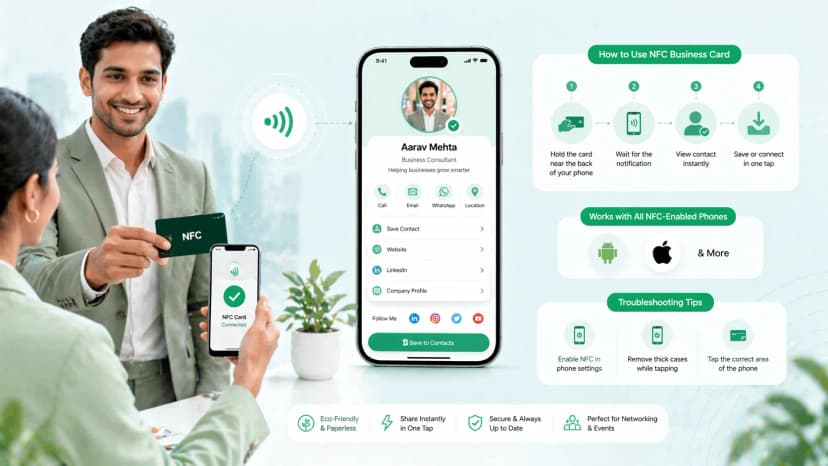
Because the chip stores a link rather than the details, editing your profile updates every card ever handed out. It also lifts the limit on what you can show: a printed card fits a name and a number, while a profile holds your portfolio, services, location and a Save Contact button. The trade-off is a dependency, since the link has to keep working, so the provider matters. Materials and current prices are on the NFC card range; each is a one-time purchase with a GST invoice and nothing recurring for the card itself.
| Question | Printed visiting card | NFC card |
|---|---|---|
| Cost per card handed out | Very low; hand out hundreds | Higher; you keep one or two |
| Needs a phone on the other side? | No | Yes, with NFC on, or a camera for the printed QR |
| Survives a number or role change? | No; every card in circulation is wrong | Yes; edit the profile once |
| What it can show | Name, number, logo | Portfolio, services, map, WhatsApp, Save Contact |
| Can be pinned to a board or stapled to an invoice? | Yes | No |
| Depends on a provider staying up? | No | Yes |
| Tells you if anyone looked? | No | Yes, profile views and taps |
Step 4: Pick the combination, not the winner
So, NFC card vs visiting card which is better India for a working professional? It is a trade rather than a winner, and plenty of people carry both: a QR printed on the paper card that opens the same profile the NFC card does. The printed card handles volume and the noticeboard; the smart card handles the meeting that matters; and the profile behind both stays current. If you are not ready to buy anything, build the profile free and put its QR on your next print run.
The step people get wrong
Ordering a thousand printed cards with a mobile number on them and no QR code. The number changes within two years for most people, and the cards outlive it. Print the QR, keep the number on the profile, and the print run never goes stale.
Printed card versus NFC card, honestly
Where the NFC card earns its place
- Every card already handed out updates when the profile does
- Shows portfolio, services, WhatsApp and a Save Contact button, not just a number
- One-time purchase with a GST invoice
- Profile analytics show whether anyone opened it
Where the NFC card falls short
- Costs more per card, so you carry one rather than a stack
- Needs a phone with NFC on, or a camera scan of the printed QR
- Depends on the provider keeping the link alive
- Cannot be left on a counter or pinned to a board
Common mistakes
What goes wrong on either side
- Treating it as either-or. The paper card and the NFC card should open the same profile.
- An NFC card with no printed QR on it, which leaves anyone without NFC stuck.
- A profile that was set up once and never updated, which makes the NFC card no better than print.
- Choosing a provider on card looks alone, when the link is the thing you are actually buying.
You're done
Decide by how often your details change and where the cards go, then set up the profile both options point at. The NFC business card page covers the card side in detail, paper versus digital business card looks at the same trade from the digital-profile angle, and NFC business card versus QR code settles the tap-or-scan question once you have chosen smart.