
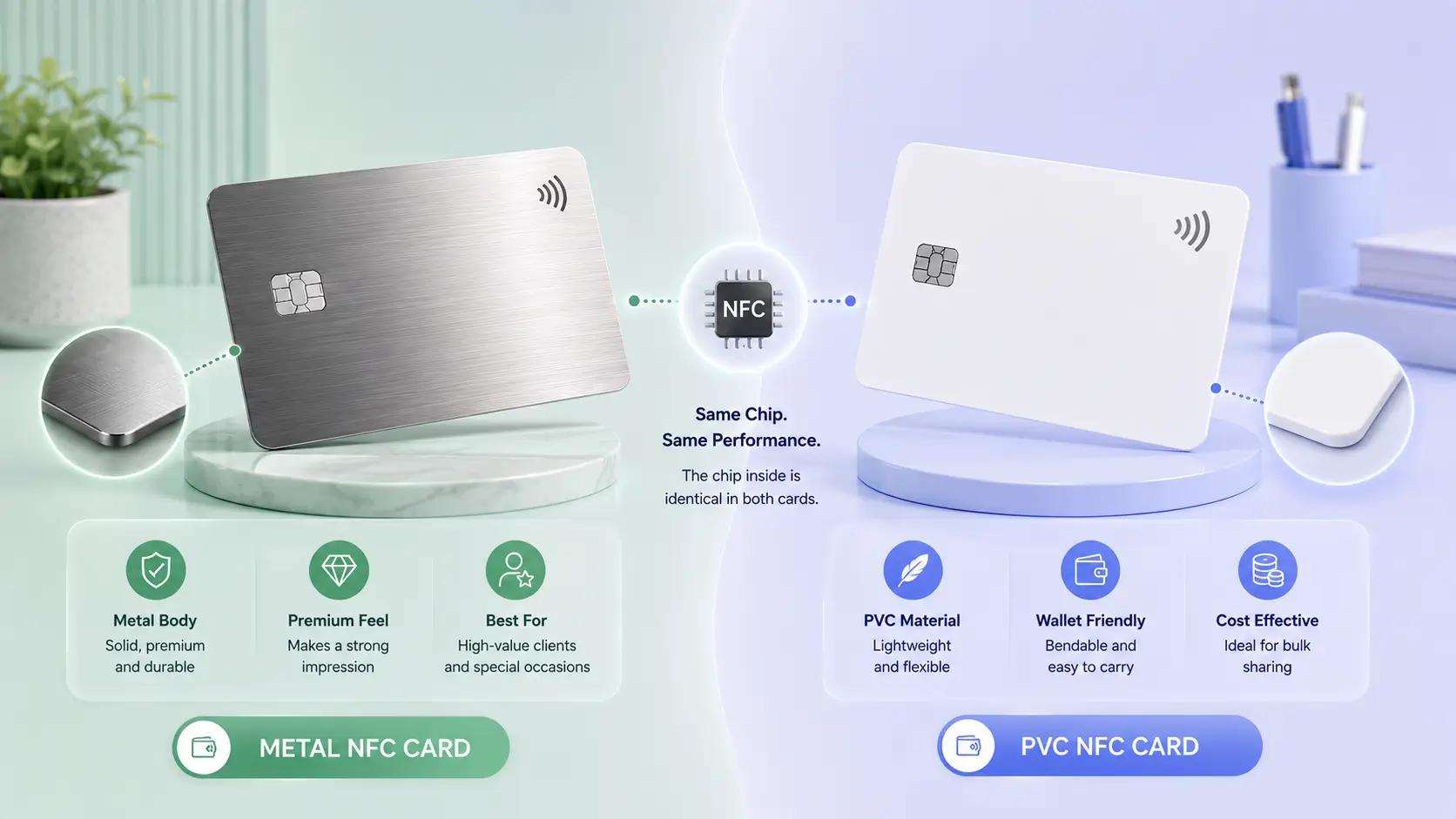
Metal vs PVC NFC card comes down to what the card is doing for you. If it is the first thing a client judges you on, metal earns its price. If you hand out cards constantly and want them to survive a wallet without costing much, PVC is the sensible choice. The chip inside is identical, so neither material makes the card work better: both open the same profile at the same speed. The choice is about weight, price, print and how many you hand out, and this guide walks you to a decision in four steps.
TL;DR
- Same chip, same profile, same tap speed in both.
- Metal buys weight, attention and durability at several times the price.
- PVC buys volume, full-colour print and a card you can give to everyone.
- Under fifty a year to people weighing you up: metal. Hundreds to anyone who walks in: PVC.
Before you start
Most comparisons mislead on one point, so settle it first: the material does not change how the card performs. The NFC antenna in a card built for metal is designed to work with the body, not against it, and a metal card taps exactly like a PVC one. Every other difference is about how the card feels in a hand, what it costs, what can be printed on it, and how it ages in a pocket.
What you need to decide
- Roughly how many cards you will hand out in a year.
- Whether the people receiving them are making a considered decision about you, or just need your number.
- Whether your branding needs full colour or works in a single engraved tone.
Step 1: Compare the two bodies
| Metal NFC card | PVC NFC card | |
|---|---|---|
| Chip and tap speed | Same | Same |
| Feel in the hand | Heavy; noticed before it is read | Light; same as a bank card |
| Thickness | Thicker in a wallet | 0.8 mm, flat |
| Finish | Engraved or etched; limited colour | Full-colour print on both sides |
| Durability | Survives being carried indefinitely | Waterproof; risks are sharp folds and sustained heat |
| Cost per card | Several times PVC | Low enough to give to everyone |
| Best suited to | Consultants, jewellers, senior sales, anyone whose fee is the objection | Shop counters, site teams, exhibition stands, high-volume networking |
Step 2: Decide whether you need what metal buys
Weight, and the second of attention that comes with it. A metal card is noticed before it is read, which is useful in professions where the client is assessing you as much as your service. A Mumbai wealth adviser handing a card across a desk wants the pause it creates; a jeweller in Jaipur wants the card to feel like the shop. The trade-offs are real: metal costs several times PVC, so handing it out freely gets expensive, it is thicker in a wallet, and engraving gives you less colour than print.
Step 3: Decide whether you need what PVC does
A PVC card is the same material as a bank card: waterproof, flat, 0.8 mm thick, and it takes full-colour print that metal cannot. At a fraction of the price you can give one to everybody rather than rationing them. For a shop counter, a site team or an exhibition stand in Pragati Maidan, that matters more than heft; the card's job is to be handed to a hundred people and still open the profile a year later.
The step people get wrong
Buying metal because it sounds better, then rationing it. A card you hesitate to hand over is a card that does not get handed over. If you catch yourself keeping the metal ones for "important" people, you needed PVC for everyone else all along.
Step 4: Answer one question
How many will you hand out in a year? Under fifty, to people making a considered decision about you: metal. Hundreds, to anyone who walks in: PVC. Plenty of people carry both, metal for the meetings that matter and PVC for volume, and because both point at the same profile there is nothing to keep in sync. Wood sits between the two; it reads as considered and unusual without metal's price, and is a good middle option if PVC feels too plain.
Honest comparison
Where metal is worth the price
- The client is assessing you before they assess the work
- You hand out a small number of cards a year and each one matters
- You want a card that still looks new after years in a pocket
- Your brand is a single colour and engraving suits it
Where PVC is the right call
- You hand out cards in volume at a counter, a stand or on site
- Your branding needs colour, a logo or a photo rather than a single engraved tone
- You want a card thin enough to forget in a wallet
- Budget matters more than the first impression
Common mistakes
Three things to avoid
- Expecting metal to tap faster or further. It does not; the chip is the same.
- Designing a full-colour layout and then ordering metal. Engraving will flatten it to one tone.
- Leaving a PVC card on a dashboard in May. Heat is the one thing it does not forgive.
You're done
Pick the body for the job and let the profile do the rest. Every option, metal, PVC and wood, is in the NFC cards collection, and how the card itself works is covered on the NFC business card for India page.