
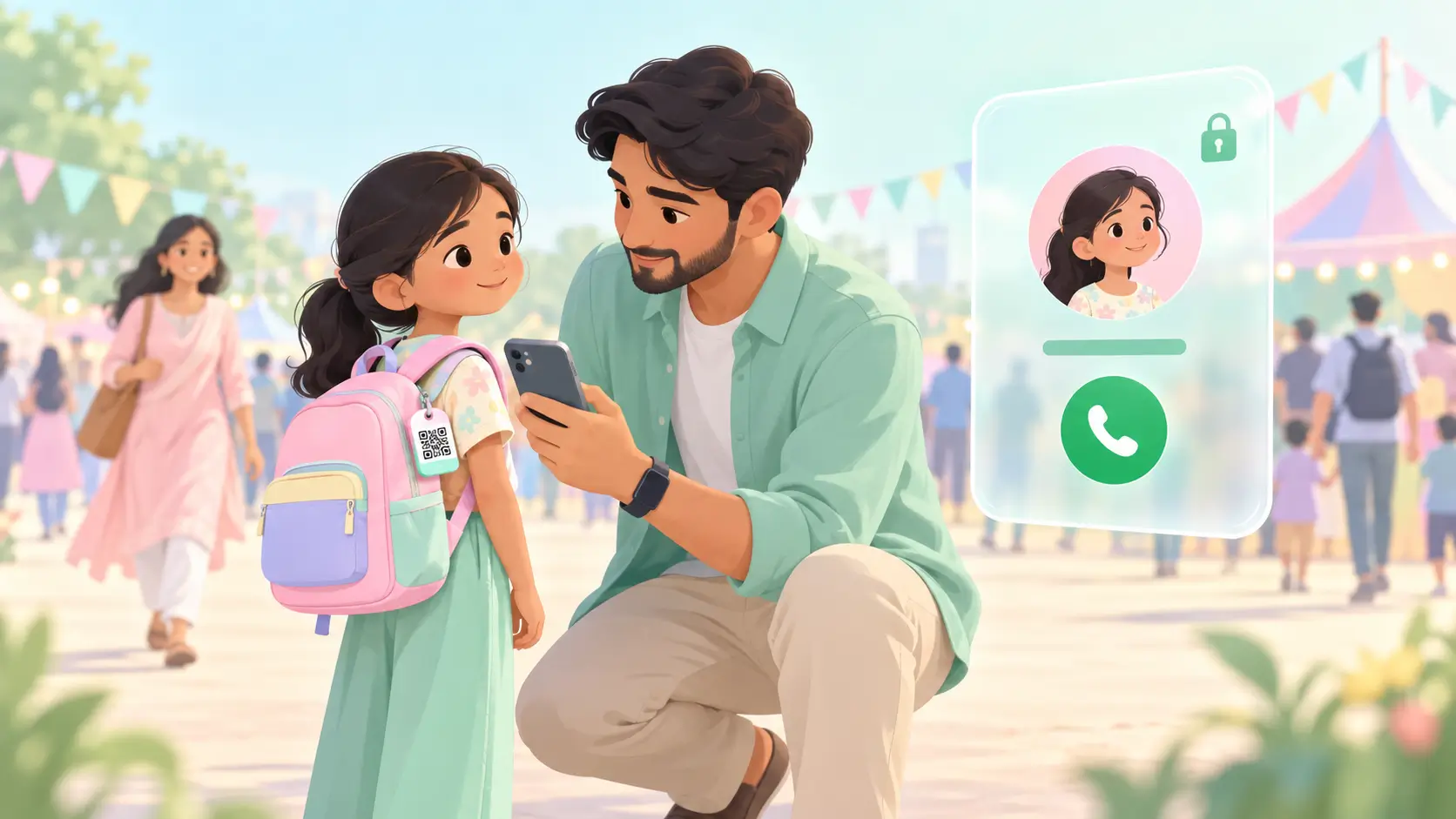
This is how parents use QR safety tags for kids in crowded places: the child wears a wristband or carries a bag tag, and if you lose each other at a mela, a mall or a railway station, whoever finds them scans the tag with any phone, sees your child's first name and photo, and calls you in one tap. Nothing personal is printed on the tag itself, and when your number changes you edit the profile online without replacing anything.
Who this is for
You have a child somewhere between two and ten, and your year has a few days in it where the crowd is part of the point: a Ganpati visarjan, a Diwali market, a village fair, a weekend at a mall, a long-distance train with a change at a busy junction. Your child is too young for a phone and may not be able to say your number clearly to a stranger, especially when frightened.
You already hold hands and agree a meeting point. What you want is a way for a helpful adult to reach you in the first minute, without your phone number and home address being on show to everyone who walks past.
The problem
What goes wrong in the first ten minutes
- Representative scenario: a fair with thousands of people, a four-year-old who lets go of a hand near a toy stall, and a parent who notices thirty seconds later.
- The adult who finds the child asks for a phone number. A child that age often cannot say it, or says it wrong.
- The help desk is at the far gate. Walking there, waiting, and getting an announcement out can take longer than the whole separation should have lasted.
- A name and number written on the bag is readable by every stranger all day, and a slip of paper in a pocket is gone by the second ride.
A young child usually cannot say your number
Most children under six know their own name and perhaps a parent's first name. A ten-digit mobile number under stress, surrounded by noise and strangers, is a lot to ask, and one wrong digit sends the call to nobody.
A written number is either lost or on show
Parents solve this with a marker on the bag or a note in the pocket. The note gets lost. The marker works, but it tells every person in the queue your name and number, and it is still there at school on Monday.
The announcement desk is on the far side of the ground
The finder's next step is the public address desk. At a large fair that can be a ten-minute walk through the crowd with a crying child, and the announcement competes with the music. Reuniting through the desk works, but slowly, and your child is with a stranger for all of it.
The fix
What changes before you leave the house
- You set up a free safety profile for each child with their first name, a photo, your number and anything a helper should know, such as an allergy.
- The child wears a silicone wristband with an NFC chip and a printed QR, or carries a QR bag tag clipped to a backpack strap.
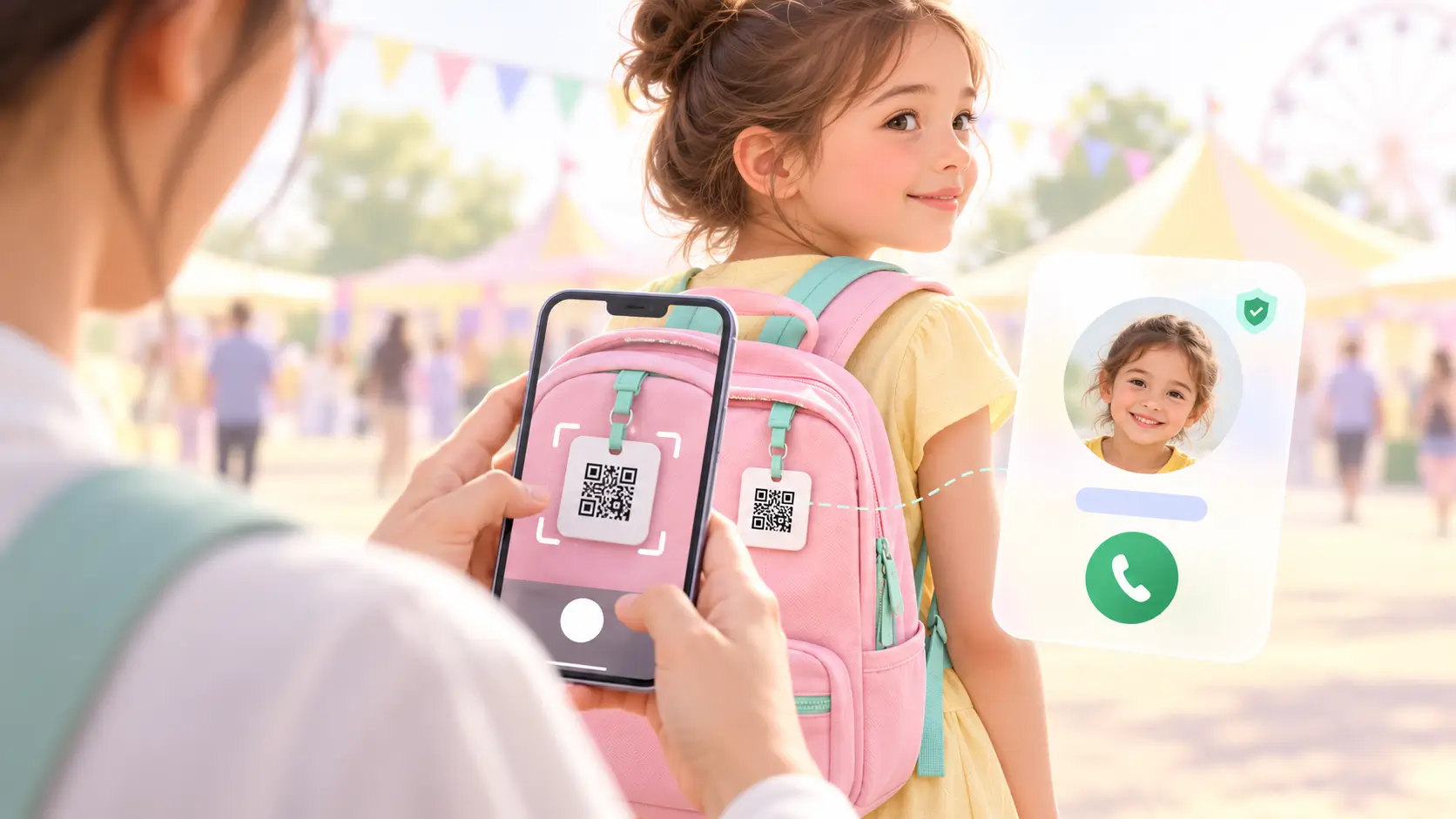
- A finder scans the QR with their phone camera, or taps the band, and sees only the fields you chose to show, with a button that calls you.
- Nothing is printed on the tag. Your number, address and surname stay private unless you choose to show them.
Scan
The adult who finds your child points a phone camera at the QR on the band or tag, and the safety profile opens in the browser. There is no app to install and no account to create, which matters because the finder is a stranger with a few seconds of goodwill.
Call
The page shows your child's first name and photo, so the finder can confirm they have the right child, and a Call Guardian button that rings the number you chose. If you have added a second guardian, that number is there too. The finder never sees your number unless you decided to show it.
Reunite
You answer, ask where they are standing, and walk there. Child safety at a mela comes down to how fast that first call happens, and a tag turns a walk to the far gate into a phone call from the toy stall where your child was found.
Old way vs new way
QR safety wristband or bag tag
- Nothing personal printed on the tag
- A photo and first name so the finder knows it is the right child
- One scan and a call from where the child is standing
- One edit online updates every tag the child wears
Name and number written on the bag
- Your number on show to every stranger all day
- A child who cannot say the number if the writing is missed
- The finder walks to the help desk and waits
- Rewritten on every bag, note and bottle when the number changes
What you get
One profile per child, under one login
Each child gets their own safety profile with their own tag, all managed from one account. Add a blood group or an allergy if a helper might need it, add a second guardian's number for the days a grandparent takes them out, and leave out anything you do not want a stranger to read.
Only what you choose is visible
The tag carries only a code, and your details live on the profile behind it. You decide field by field what a scan reveals, so a finder can see a first name and a call button while your surname, address and full number stay hidden. Most parents show the photo, the first name and the call button, and nothing more.
A wristband for the little ones, a bag tag for school age
A toddler has no bag, so the kids safety wristband stays on the wrist where a finder sees it first. An older child who carries a backpack can use the kids safety bag tag on the strap, and the same tag then does duty on the school bag for the rest of the year. A kids safety tag for malls and stations works exactly like one at a fair: the finder scans, the finder calls.
A number you update in one place
Change your number, add a guardian or update a photo as your child grows, and every band and tag linked to that profile shows the new version the next time it is scanned. The tag itself never needs replacing for a change of details.
Results
| Measure | Before | After |
|---|---|---|
| How the finder reaches you | Asks the child, then walks to the help desk | One scan and one tap to call |
| What the finder can see | A number on the bag, or nothing | First name, photo and a call button |
| What every passer-by can see | Your name and number, all day | A small QR code |
| When your number changes | Rewrite every bag, note and bottle | One edit on the profile |
| Notes written in a year for two children and ten outings | 20 | None |
Here is the representative scenario in numbers: a family with two children and about ten crowded outings a year writes twenty notes or marker labels, and each one has to be checked, rewritten or hidden. With one wristband or tag per child, there is nothing to write before an outing and nothing to erase after it. Treat the numbers as an illustration, not as a customer's results.
Put simply: the first call comes from wherever your child was found, moments after the scan, and your number is never written where the whole crowd can read it.
What to watch for
Before the first outing
- A tag is a backup, not a replacement for holding hands, agreeing a meeting point and dressing the child in something bright.
- Teach your child to show the band to a police officer, a shopkeeper or a mother with children if they get lost, and to stay where they are.
- Open the profile yourself before a big outing and check that the guardian number is the phone you will be carrying that day.
Summary
Background and goals. Parents of two young children wanted any stranger at a fair or a station to be able to reach them in the first minute, without their number being written where the whole crowd could read it.
Solution. A QR safety wristband for the younger child and a bag tag for the older one, each linked to a safety profile showing a first name, a photo and a Call Guardian button, with everything else kept private.
Results. In the representative year above, the walk to the help desk becomes a phone call from where the child is standing, twenty handwritten notes become none, and a change of number is one edit instead of a rewrite on every bag.
Set it up before the next outing
Create a free family safety profile for each child, choose what a finder sees, and put the band on before the next fair, mall trip or train journey.