
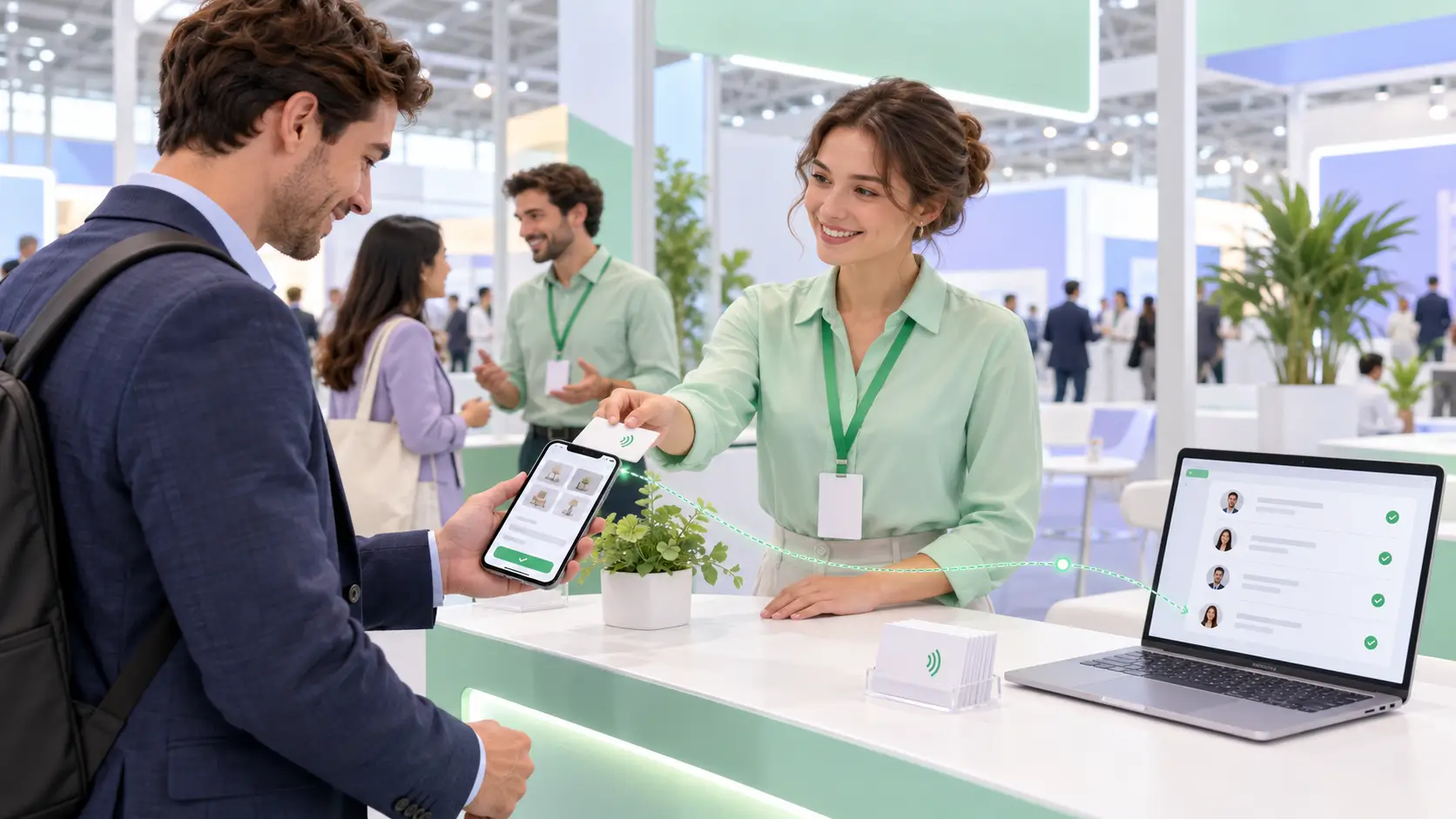
Here is how exhibitors use NFC business cards at trade shows: each person on the stall taps a card on a visitor's phone, the visitor gets your catalogue and contact in one step and sends their own details back, and every lead from the show ends up in one list. What follows is a three-day exhibition, before and after.
Who this is for
You run or staff your company's stall at an industry exhibition: an engineering expo in Delhi, a textile fair in Surat, a packaging show in Mumbai. Five of you share a few square metres for three days and talk to hundreds of visitors, and afterwards the show is judged on one question: how many of those conversations turned into enquiries.
You need something every person on the stall can hand over in seconds, that carries the product catalogue, and that brings the visitor's details back without a form, a clipboard or a scanner queue.
The problem
What three days on paper costs
- Representative scenario: five staff, about 30 conversations each a day, over three days. That is roughly 450 conversations.
- Only visitors who drop a card in the bowl leave details. If one in three does, you get about 150 leads and 300 conversations with no way back.
- Typing 150 collected cards into a spreadsheet at two minutes each takes five hours of someone's week after the show.
- Follow-up starts days later, after visitors have met many other stalls and mixed yours up with theirs.
Leads depend on a glass bowl
A common answer to how to collect leads at an exhibition stall is a bowl for visiting cards. It catches visitors who carry cards and remember to drop one, and misses everyone in a hurry or without a card in their pocket.
The catalogue is too heavy to hand out
Printed catalogues cost money per copy, run short by the second afternoon and often end up in a hotel bin. The visitor who wanted the spec sheet for one model gets a forty-page book or nothing at all.
Data entry eats the week after
Someone spends the Monday after the show typing names off cards and guessing at handwriting, and the hottest enquiry waits in the same queue as everyone else's.
The fix
What changes on the first morning
- Every person on the stall carries their own NFC card, linked to a profile in your company's branding.
- A tap opens the profile on the visitor's phone, and the QR on the back covers phones with NFC turned off.
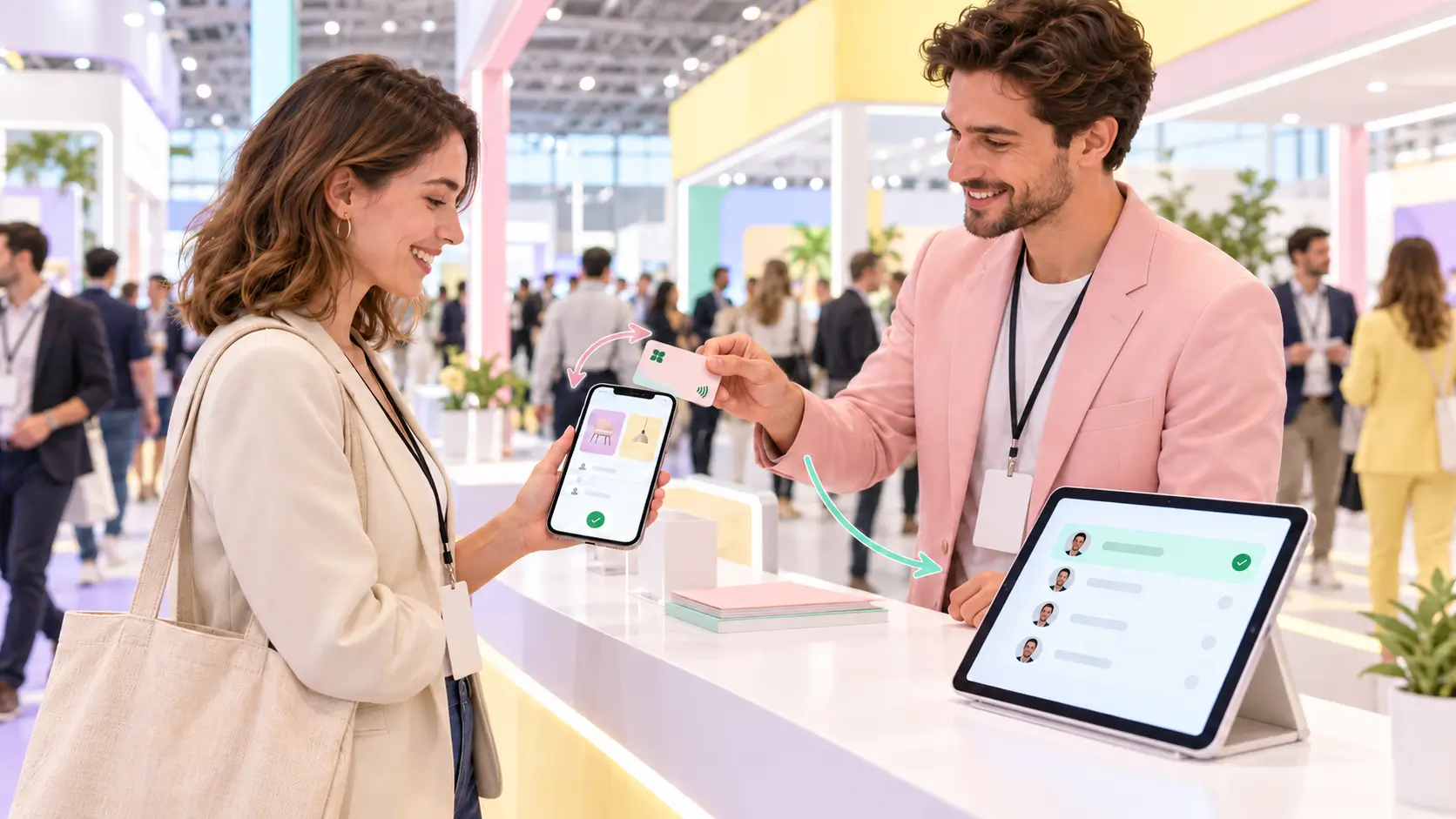
- The visitor taps Exchange and sends their name and number back from the same screen.
- Catalogue PDFs, product videos and a WhatsApp button for enquiries sit behind the tap.
Tap
A visitor stops to ask about a machine. Before they move on to the next stall, your colleague taps the card on their phone and your profile opens in the browser, with nothing to download. Even when the aisle is too crowded for a proper conversation, the visitor walks away with your details.
Capture
Trade show lead capture usually means a scanner queue or a bowl of cards. Here the visitor taps Exchange on your profile and sends their details back as part of the same tap, which makes exhibition stall lead collection something every staff member does in the flow of a conversation.
Follow up
Details shared at the stall are saved to your ProfileTap dashboard as they come in. The team can send a thank-you and the right spec sheet on WhatsApp the same evening, while the visitor still remembers which stall had the machine they liked.
Old way vs new way
An NFC card on every staff member
- Details shared back with every tap
- Catalogue and videos behind one link
- Leads saved as they arrive
- Follow-up the same evening
Bowl, brochures and printed cards
- Details only from visitors who drop a card
- Catalogues printed per copy and gone by day two
- Hours of data entry after the show
- Follow-up days later
What you get
A card for each person on the stall
Each staff member gets their own card and profile in the company's colours, so an enquiry reaches the person the visitor actually spoke to. Staff hired for a single show can be set up the same way.
Your catalogue without the printing
Link the product catalogue, spec sheets, demo videos and your WhatsApp enquiry button. Update them between shows, or between days if a price sheet changes overnight.
Leads that arrive in one place
Visitor details shared through the profile are saved to the dashboard, so there is no bowl to empty and no handwriting to decode on Monday morning.
Views after the show
Analytics show which visitors opened your profile or the catalogue again once the exhibition was over, which tells your sales team where to start calling.
Results
| Measure | Before | After |
|---|---|---|
| Visitor details collected from about 450 conversations | About 150, from the bowl | Up to 450, shared at the tap |
| Data entry after the show | About 5 hours | None |
| First follow-up | Several days after the show | The same evening |
| Product catalogues | Reprinted for every show | Linked from the profile |
The arithmetic behind the table: five staff having 30 conversations a day for three days adds up to 450 conversations. If one visitor in three drops a card, the bowl gives you 150 leads, and typing those in at two minutes each takes 300 minutes, or five hours. Two-way exchange removes the bowl from the equation, so any visitor willing to share is a lead, up to all 450. Treat these as a worked example for planning, since no ProfileTap customer data sits behind them.
In short: each evening's leads are already in one list when the hall closes, and the Monday of typing names off cards never happens.
What to watch for
Limits to plan around
- Lead capture depends on the visitor agreeing to share. Staff still need to ask at the end of each conversation.
- Some phones have NFC switched off or missing. Keep the QR on the back of the card and on a sign at the stall.
- If the organiser runs a badge-scanning system, use both. The scan records the visit, and your card gives the visitor your catalogue and a way to reach you.
Summary
Background and goals. A five-person stall at a three-day trade show wanted every conversation to end with the visitor's details, without a scanner queue, a bowl of cards or a week of data entry afterwards.
Solution. An NFC card for each staff member, linked to a branded profile carrying the catalogue, demo videos and a WhatsApp button, with two-way contact exchange and analytics.
Results. In the representative show above, collected leads can rise from about 150 to as many as 450, five hours of data entry disappear, and follow-up moves from the next week to the same evening.
Try it at your next exhibition
Order NFC cards for your team before the show, link this season's catalogue, and compare the list at the end of day one with what a bowl of cards used to give you.