
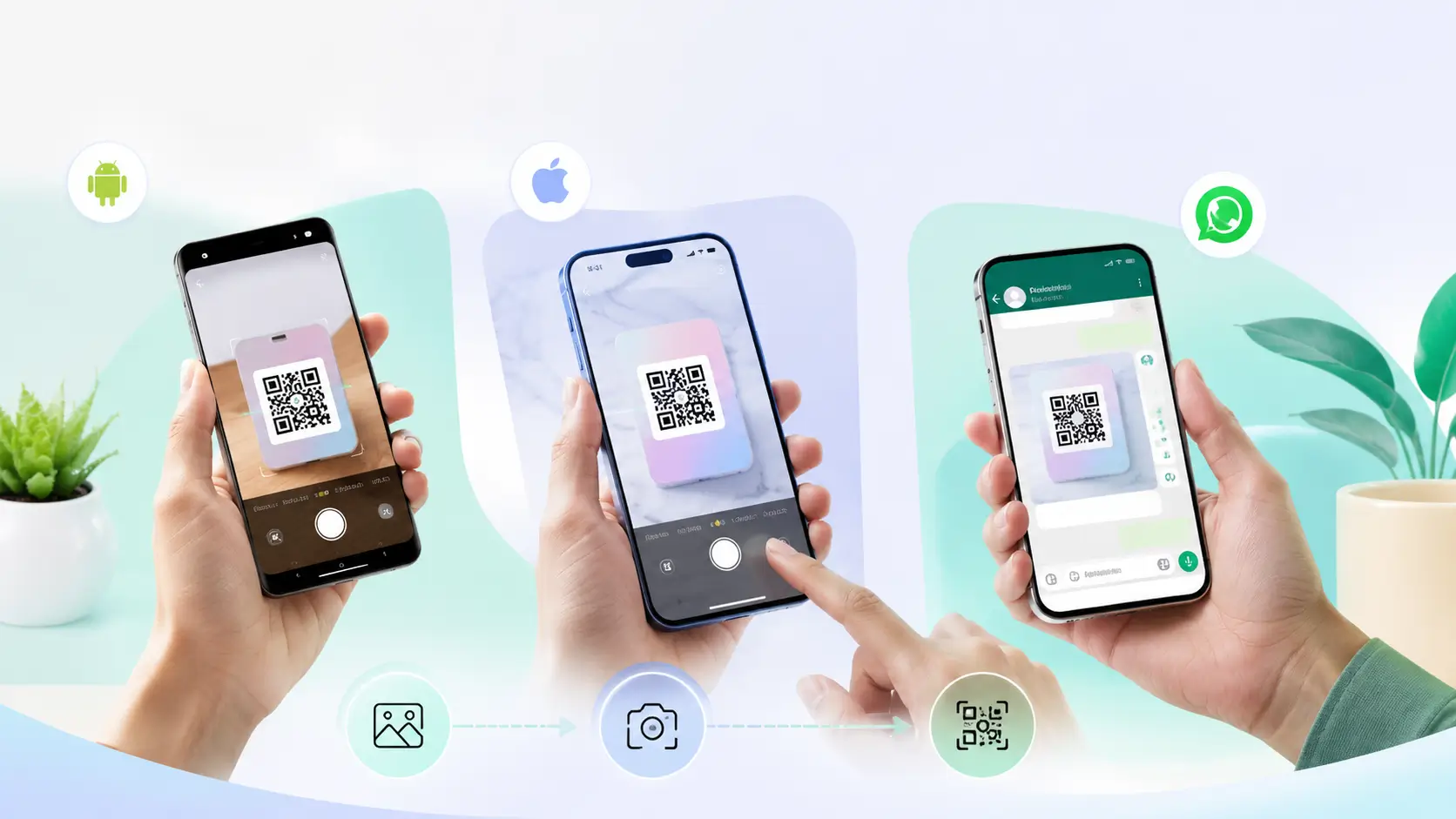
You can scan QR code from image files without installing anything: on Android, open the picture in Google Photos and tap the Lens icon; on iPhone, open it in Photos and press and hold the code. Both read the QR straight out of the saved image, whether it is a screenshot, a WhatsApp photo or a camera shot. That covers most cases in one line, but the details differ by phone, by app, and by how the image reached you. Here is how to scan QR code from image files in every situation, plus what to do when the code refuses to read.
TL;DR
- Android: Google Photos, Lens icon. iPhone: Photos, press and hold the code.
- Code on your own screen: screenshot it, then scan the screenshot.
- Nothing to download on any recent phone; online upload tools are for desktops and public codes only.
- If it will not read, crop so the code fills the frame and ask for the original file instead of a forward.
Before you start
A QR scan from image works on the pixels, not the paper, so what matters is that the whole code, including its white margin, is inside the picture and sharp enough to show the individual squares. A code that fills a tenth of a blurry screenshot will fail on every tool; the same code cropped and sharp reads in a second.
What you need
- Android: Google Photos with the Lens icon, pre-installed on almost every handset sold in India.
- iPhone: the Photos app on iPhone XS or newer, which is where Live Text runs.
- The image saved or opened full-screen; a thumbnail inside a chat is often too small to trigger detection.
Step 1: On Android, use Lens inside Google Photos
Google Lens handles QR scanner from image duty on nearly every Android phone. Open the picture in Google Photos and tap the Lens icon in the bottom bar; the code is detected in a second and the link appears as a tappable chip. The same works from the Lens app or the Lens mode in the camera: pick the image from your gallery instead of pointing the camera. On newer phones there is an even faster route: long-press the home button or navigation bar to trigger Circle to Search while the image is on screen, and circle the code. Pulling a QR from image files is a stock feature now, with no third-party scanner needed.
Step 2: On iPhone, press and hold the code in Photos
Open the picture in the Photos app and press and hold directly on the QR code; iOS recognises it and offers to open the link. The Photos app works as a Photos QR code scanner this way on every model that supports Live Text, which means iPhone XS and newer, and the same long-press works on images inside Safari and Mail. On older iPhones where the long-press does not respond, open the image on another screen or a print and point the normal camera at it; the camera app has read QR codes since iOS 11.
Step 3: For a WhatsApp image, open it full-screen or save it first
This is the most common version of the problem in India: a menu, a payment code or a visiting card lands in a chat as a QR photo. Open the image full-screen in WhatsApp, then use the same tools as above: Lens icon on Android, press and hold on iPhone. If nothing triggers inside WhatsApp, save the image to your gallery and scan it from Photos; ten extra seconds, and it works every time.
Step 4: For a code on your own screen, screenshot it
This is the classic dead end: the code is on your display, and you cannot point your phone's camera at itself. Take a screenshot, then run the scan on the screenshot with Lens or Photos. What looks impossible takes three taps once you know the screenshot step, and if you are asking how do I scan the QR code a website just showed me on my phone, this is the answer.
Step 5: On a desktop, use an upload tool for public codes only
Plenty of sites let you scan QR code from image online: upload the picture, get the decoded link. They are useful on a desktop where Lens is not at hand, and any QR code reader picture upload tool from a known name does the job for a menu or a poster. One firm caution: never upload payment QR codes, login codes or anything private to a random website. The image goes to their server, and a UPI or authentication code in a stranger's hands is a real risk. For anything sensitive, stay on-device, where Lens and Photos process without the upload.
| Situation | Tool | Image leaves your phone? | Works for private codes? |
|---|---|---|---|
| Saved image or screenshot on Android | Google Photos, Lens icon | No | Yes |
| Saved image or screenshot on iPhone XS or newer | Photos, press and hold | No | Yes |
| Image in a WhatsApp chat | Open full-screen, then Lens or long-press; save first if needed | No | Yes |
| Code on your own screen | Screenshot, then scan the screenshot | No | Yes |
| Image on a desktop | Online upload tool | Yes | No; public codes only |
| Older iPhone without Live Text | Show the image on another screen and use the camera | No | Yes |
The step people get wrong
Trying to scan a thumbnail inside the chat. Detection needs the code at a readable size, so open the image full-screen first, or save it and open it in the gallery. Most "Lens does nothing" complaints are a thumbnail, not a broken code.
On-device scanning or an online tool?
Lens or Photos on the phone
- Image never leaves the phone
- Built into Google Photos and iPhone Photos, nothing to install
- Handles screenshots, forwards and photos of printouts
- Reads multiple codes in one image and lets you pick
Online upload tool
- The image is uploaded to a third-party server
- Wrong place for UPI, login or KYC codes
- Needs a browser and a file picker, which is slow on a phone
- Useful mainly at a desk, for public codes such as menus and posters
Common mistakes
Why the code in your photo is not scanning
- The image has been forwarded on WhatsApp until the module edges blurred. Ask for the original, or document-mode sharing.
- The code was photographed at an angle or under glare. Shoot straight-on and avoid lamination reflections.
- The code is a tiny part of a large screenshot. Crop so it fills the frame.
- The white margin was cut off. The reader needs the quiet zone around the code.
- The source file was low-resolution to begin with, in which case no scanner can save it; the QR code size guide explains why low-resolution codes fail and how to export ones that never do.
You're done
You already have everything you need: Lens on Android as your QR reader from image, Photos on iPhone, and a screenshot for the on-screen case. If the image you keep scanning is someone's visiting card, that is the modern card working as designed; the code travels as a picture and still opens the profile. The tap-versus-scan trade-offs are in the NFC versus QR business card comparison, and if you want a card of your own that people can scan from a photo, an NFC business card carries a printed QR code for exactly that. If it is an NFC tag rather than a QR code giving you trouble, no supported app for this NFC tag has its own fix.