
The NFC full form is Near Field Communication. It is a short-range wireless chip built into most modern phones that lets two devices exchange a small amount of data when they are held within about four centimetres of each other — no pairing, no app, no internet connection. That is the whole answer; everything below is what it means in practice.
The NFC full form in mobile terms means the same thing whether you meet it on an Android settings screen or an iPhone spec sheet: a radio link so short it only works when you deliberately touch two things together.
What does NFC stand for, and why 'near field'?
The 'near field' part is not marketing. NFC works at 13.56 MHz and relies on the magnetic field immediately around the antenna — the near field — rather than a broadcast signal that travels across a room. That physics is what caps the range at a few centimetres, and it is a subset of the older RFID family that has been used in access cards and inventory tags for decades.
The short range is a security feature, not a limitation. Bluetooth reaches ten metres, which means someone across the room can attempt a connection. NFC requires physical proximity that you can see happening, which is exactly why banks were willing to put it on payment cards.
What NFC actually does on your phone
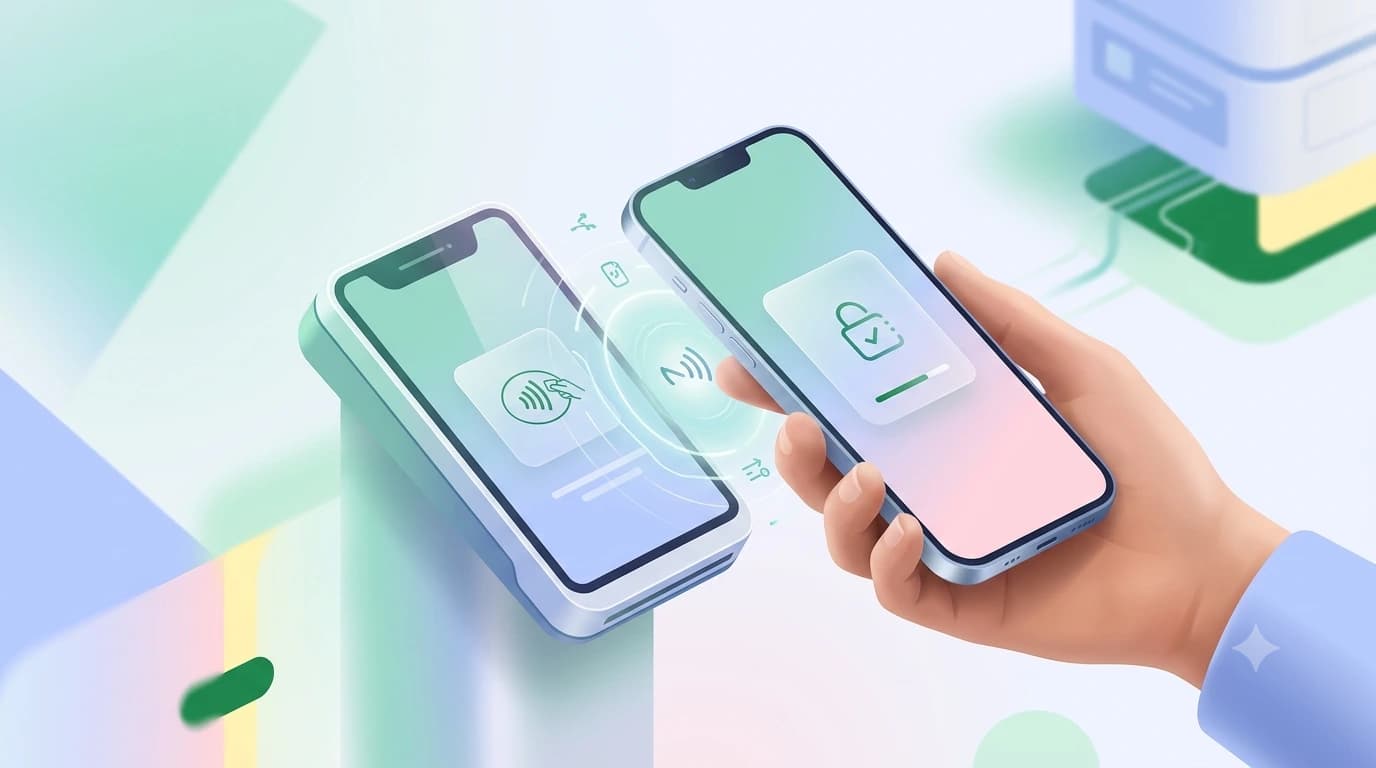
Searching NFC how it works turns up diagrams of coils; the practical version is that the phone's antenna powers the tag's antenna for a fraction of a second and reads what is on it. A phone uses NFC in three modes, and you have probably met all three without noticing:
- Reader mode — your phone reads a passive tag or card. This is what happens when you tap a smart card, a poster tag or a transit sticker. The tag has no battery; your phone powers it for the instant it takes to read. A visiting card works exactly this way — see the NFC cards collection.
- Card emulation — your phone pretends to be a card. Tap-to-pay at a shop terminal works this way.
- Peer-to-peer — two phones exchange data directly. Largely retired on newer handsets in favour of other sharing methods.
What NFC in a mobile phone actually is
If you searched what is NFC in mobile phone terms, here is the plain version: an NFC phone carries a flat coil antenna behind the back cover and a small controller chip. Bring an NFC device such as a card, a sticker or another phone within four centimetres and the phone powers it, reads a few hundred bytes, and acts on them. Ask a shop assistant what's NFC in mobile and you will hear "the tap thing", which is accurate.
So NFC meaning in mobile phones is hardware, not a service or an app. That is why NFC in Android appears as a toggle under Connections, while an iPhone has nothing to switch on. The NFC in phone meaning on a spec sheet is just that the chip is present; the NFC in phones meaning has not changed since 2015, only the price of handsets that carry it has. On a retailer's filter the NFC phones meaning shoppers care about is simply tap-to-pay ready, and it is the same chip a visiting card uses.
The query "what is NFC phone" usually comes from someone who spotted the word in a listing. Samsung even sold its own stickers, the Samsung NFC tag, so a tap on the dashboard could switch a phone to driving mode. The card that carries your contact details is the same idea pointed at people instead of settings.
Does NFC need internet or battery?
The tap itself needs neither. Reading a tag works in a basement with no signal, because the exchange happens between your phone and the chip. What comes after may need data: if the tag holds a web link, opening that page needs a connection. The chip in the tag has no battery at all, which is why a card can sit in a wallet for years and still work. On the phone side the drain is negligible; what NFC means in mobile phones is a passive radio that idles until something comes within range.
How to check whether your phone has it
Open Settings and search for NFC. If a toggle appears, your phone has the chip. The full form of NFC in mobile spec sheets is that same Near Field Communication, usually printed under Connectivity. Most NFC enabled phones in India sold since roughly 2019 are mid-range and flagship handsets; budget models under about ₹10,000 often still leave it out. On iPhones there is no toggle to find because background tag reading is always on. The step-by-step is in our guide to enabling NFC on Android, and there is a list of phones with Near Field Communication in India if you are checking before you buy.
The everyday use most people never try
Payments get all the attention, but the quietest useful application is a card that carries your contact details. Tap it on someone's phone and your profile opens — no app on either side, and nothing for them to type. Because the chip holds a link rather than the details themselves, changing your number later updates every card you have ever handed out. That is the idea behind an NFC card. The card side of it — the chip, the common uses and what to check before buying — is covered in what an NFC card is.